Foundation Paper Piecing Tips and Supplies

I’ve been posting most of my quilting and hiking projects over on Instagram, but I want to blog a bit more this year.

This past year, I did quite a bit of both foundation paper piecing and applique quilts. I love the precision of foundation paper piecing and the crisp edges that it gives. I recently completed a quilt along using this technique and will blog about it over the next few posts. I’ll also talk about my applique quilts and the wonderful experience that I had as an artist-in-residence last fall.

I’ve heard from some quilters who want to know about the tools that I use for foundation paper piecing so this post will focus on that topic. I do have a page on my blog that lists all of my favorite tools so you can amend your toolkit with these items. I use each tool to achieve foundation paper piecing perfection!
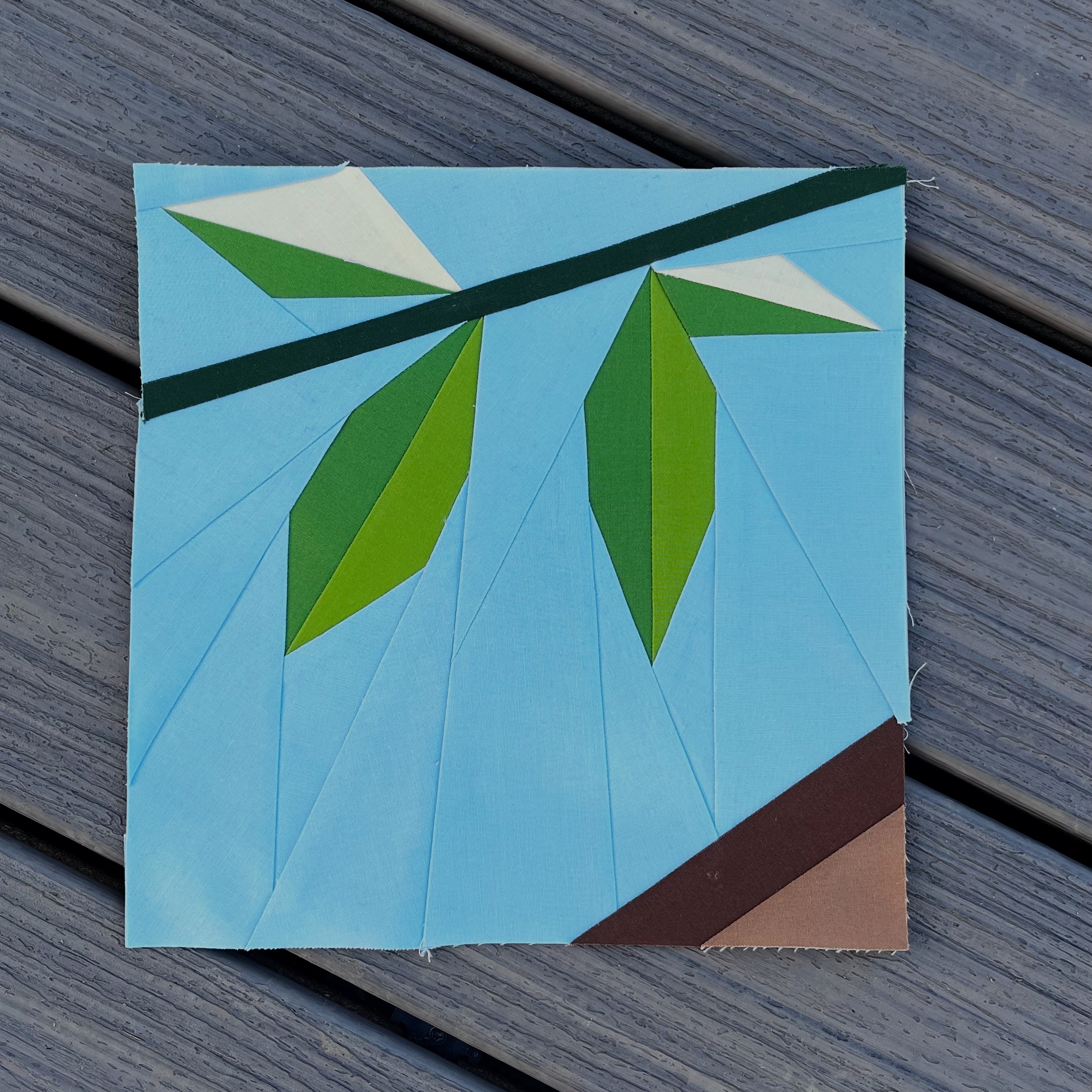
The foundation paper piecing technique creates crisp edges!

Foundation Paper Piecing Method

I use the TSP technique for foundation paper piecing, which I learned many years ago from Carol Doak. What is that, you may wonder? It stands for trim, stitch, and press. Essentially, I trim the seam with my add-a-quarter ruler, stitch the next seam using a 1.5″ stitch length, and then press that seam. And repeat!

Foundation Paper Piecing Tools

I use both a 6″ add-a-quarter ruler and a 12″ add-a-quarter ruler, depending on the size of my fabric pieces. I tape these rulers to a postcard to create a sort of flipping mechanism to align my foundation just right. I flip the ruler up, lay the postcard against the seam on the foundation, fold it back, and then trim the fabric underneath. You can get into a nice rhythm using this method, which makes foundation paper piecing a relaxing experience. I may do a little video of myself doing this method in a future post so you can visualize it better.

For the first piece of fabric, I use a little bit of roller adhesive tape rather than glue or pins. I find that glue hardens and makes a terrible little nub in your project, and pins tend to be too big for my small foundations. Remember to place your initial piece of fabric wrong side down. It’s the only piece that gets applied wrong side down! For the remaining pieces of fabric in your foundation, you’ll place the fabric right sides together.

I prefer to use a smaller rotary cutter for foundation paper piecing. My preferred size is a 28mm rotary cutter. For me, the 45mm rotary cutters are too large, although I do use them for cutting sashing, borders, or larger pieces of fabric.

When I do foundation paper piecing, I have a little cutting mat, a small wool pressing mat, and a mini iron next on a little table to me so I don’t have to get up for each step. For larger seams or when the block is complete, I will move to my big iron for pressing. However, I find having my little press and trim station next to my machine helps me to be very efficient at foundation paper piecing.

You can also use this method to chain piece foundations. Yes, you heard it correctly! You can chain piece while doing foundation paper piecing. I usually only chain piece when I’m making similar blocks. If the blocks are very different, then I do them individually so that I don’t get too confused.

If you found these tips and supplies helpful, give me a comment! Would you like to see little videos or pictures of these tips in future posts?

Happy quilting!

Jen

Meowville Finished Quilt

Last year, I completed work on my epic tiny house quilt. I started this quilt in 2023 as a weekly sew along with tiny 6″ foundation paper-pieced houses by Quilt Art Design.

When I last shared my progress, I was about 2/3 finished with the quilting. My goal was to finish this quilt so I could display it at the Sisters Outdoor Quilt Show last July. I realized that I never shared my finished quilt!

My husband and I hike and backpack regularly so I decided to take a picture of the final quilt at the start of a fantastic trail in the Columbia River Gorge called Eagle Creek.

Here’s a look at the finished quilt with all the beautiful greens from the moss and vegetation:

Meowville Finished Quilt at Eagle Creek

If you’ve never hiked along the Eagle Creek trail, I highly recommend it. One of the picturesque falls that is easily doable for most hikers is called Punchbowl Falls. It’s about a 5-mile round trip hike. It does have a few sections with steep drops so be cautious, especially with children and dogs.

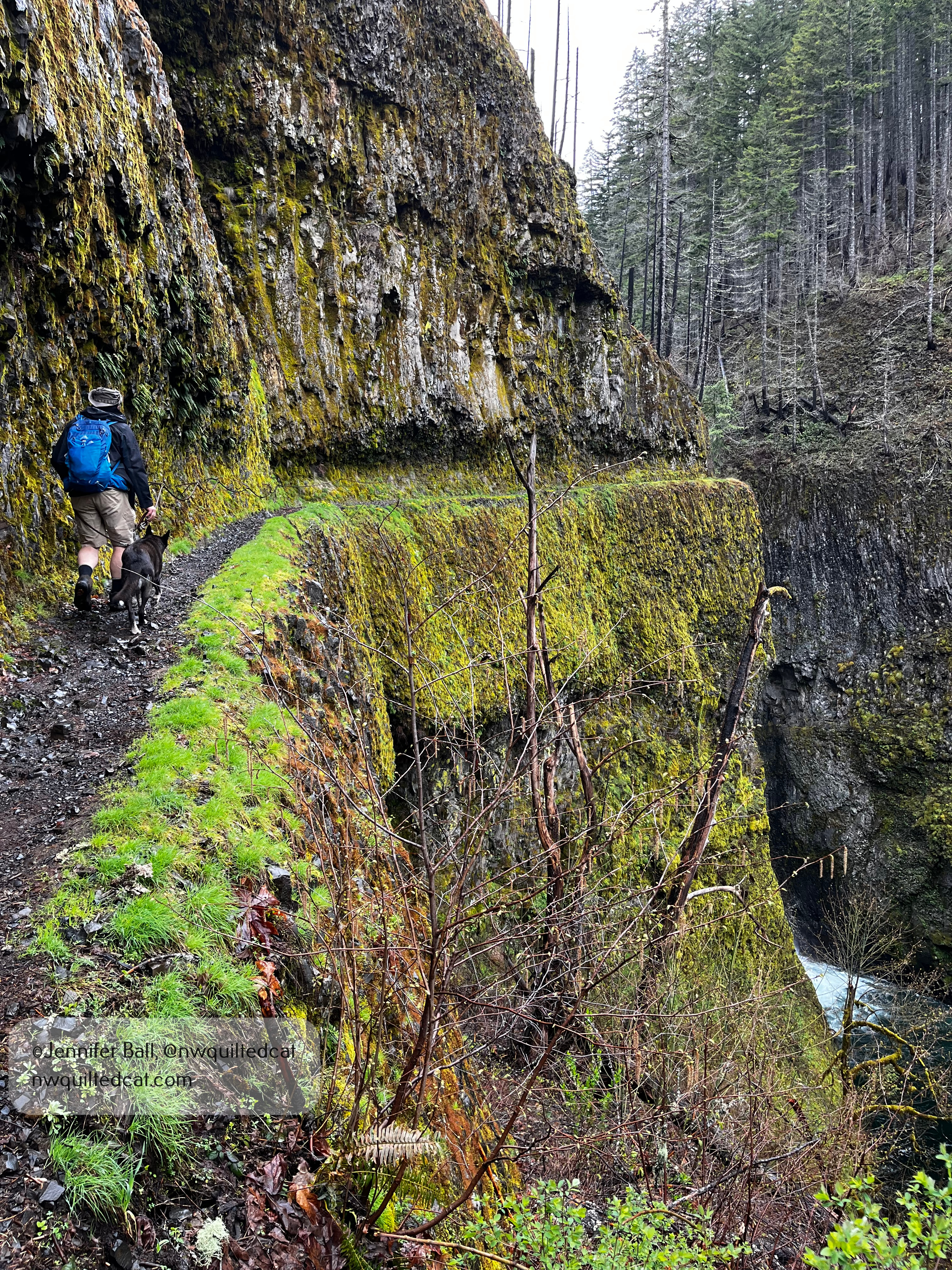
I have hiked all the way to the top to Wahtum lake when I was a teenager, which requires either a car shuttle or backpacking. On this particular trip with my quilt, we decided to do a long day hike. We had lunch at Twister Falls and turned around at that point. Tunnel Falls is approximately a 12 mile round trip hike with Twister being about 1/2 mile beyond. If you do hike to Twister, there is a very steep drop often called the “Vertigo Mile” that might be challenging if you’re afraid of heights. There are cables attached to the rock to help you navigate that section if you need them.

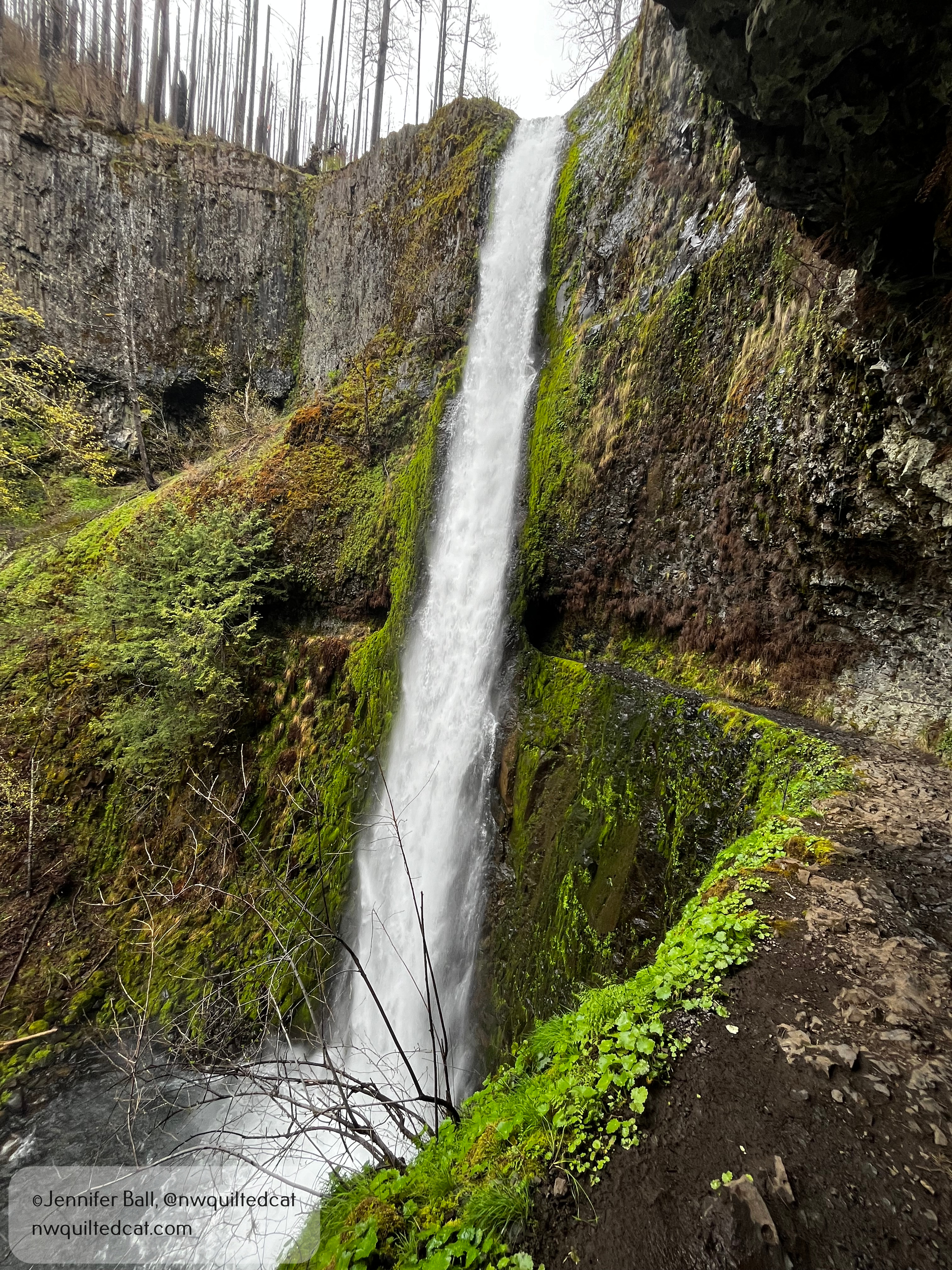
Tunnel Falls at Eagle Creek
Twister Falls at Eagle Creek
A Section of the “Vertigo Mile,” the approach to Twister Falls along the Eagle Creek trail with my hubby and dog.

We hiked this in April 2024 so the waterfalls were flush with water. So beautiful!

I did enter Meowville into the Sisters Outdoor Quilt Show so if you visited in July 2024, you might have seen it.

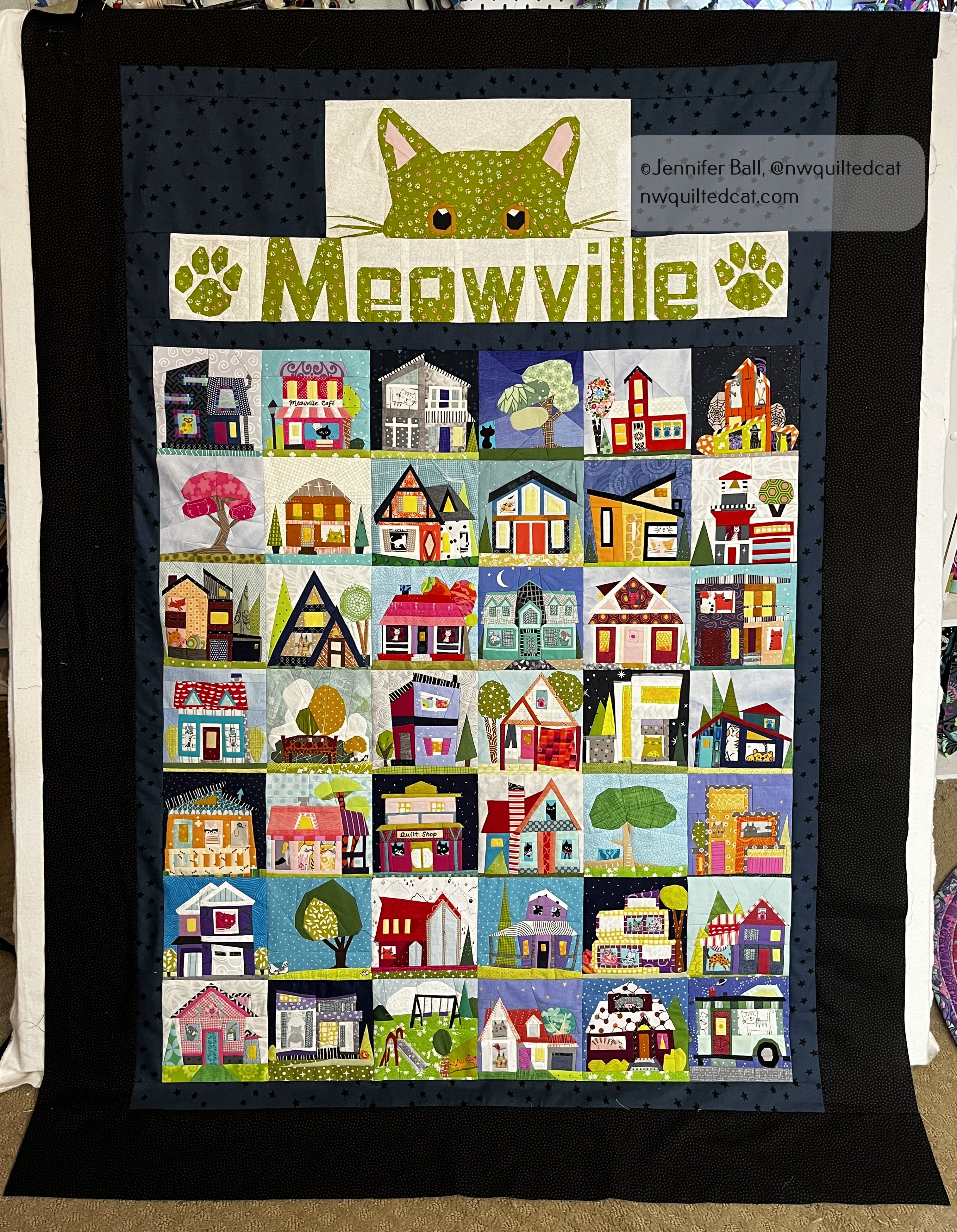
Here’s a look:

Meowville at the Sisters Outdoor Quilt Show, July 2024

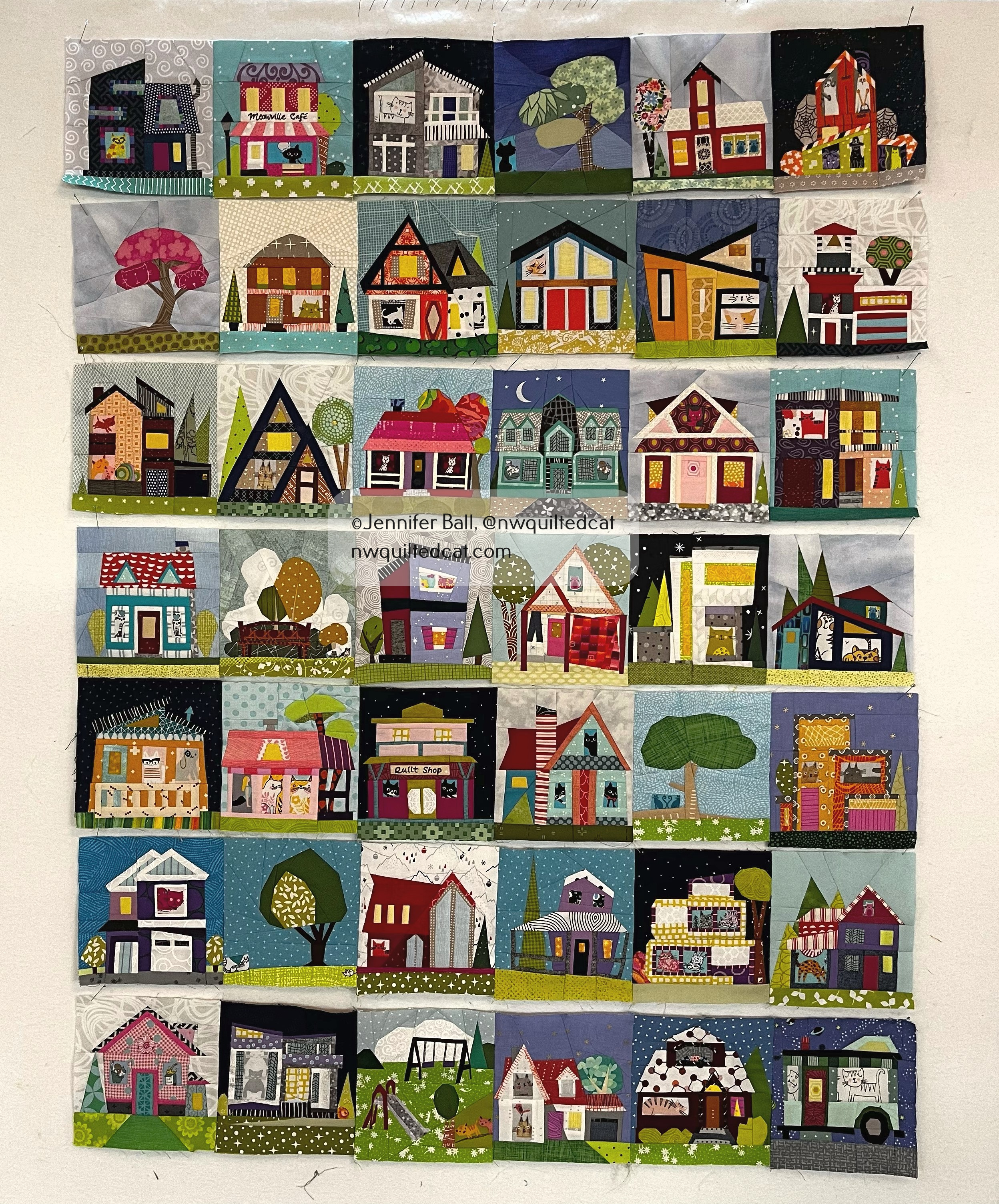
Each of those house blocks has a cat or two pieced into it. If you zoom in on the picture, see if you can find all of the cats. There are some really tiny pieces! I really enjoyed creating this quilt, and sewing one tiny house each week for 36 weeks.

Let me know in the comments if you saw my quilt at the show!

Happy quilting,

Jen

Epic Tiny House Paper Pieced Quilt, Part 2

I last blogged in January, but I have been working on various projects to submit to the Sisters Outdoor Quilt Show. I have some quilt tops that have been pieced for a while and need to be quilted plus I wanted to submit some post cards for the annual fundraiser at the show.

For the tiny house project, I had to decide how to piece the top because there is no pattern for the final layout.

I decided that my “Meowville” quilt needed the pieced name to be on the top, but the quilt was still missing something. Hmm, what could I add? How about a giant cat face peeking out at the viewers? I found a great pattern from Quilt Art Design called “Cat Helper” that would fit my idea with a few modifications.

The cat’s eye is always watching!
A partial cat head, perfect for mischievously peering down at the Meowville tiny houses

I now had the final blocks of my quilt assembled and ready to be set into a layout! I thought about a layout for a few weeks, and decided to place my tiny houses in rows without sashing strips. I set the blocks using a fun Ruby Star Society from their Starry line. I used Starry in the Smoke colorway, which is a beautiful deep blue with black stars. Finally, I added an outer border using a black print from my stash to give the quilt a nice frame and to meet the minimum width requirements for the quilt show.

Meowville quilt flimsy

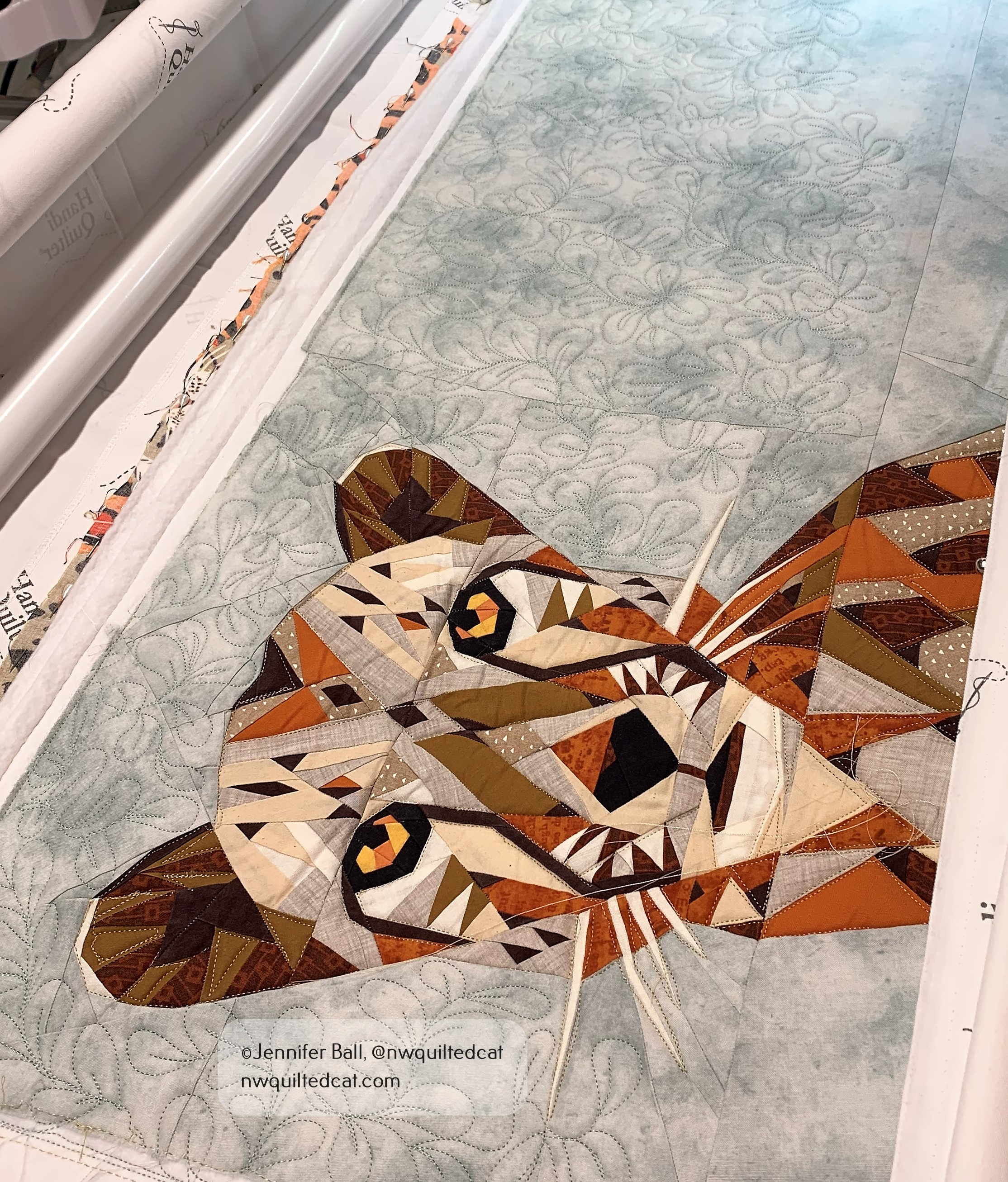
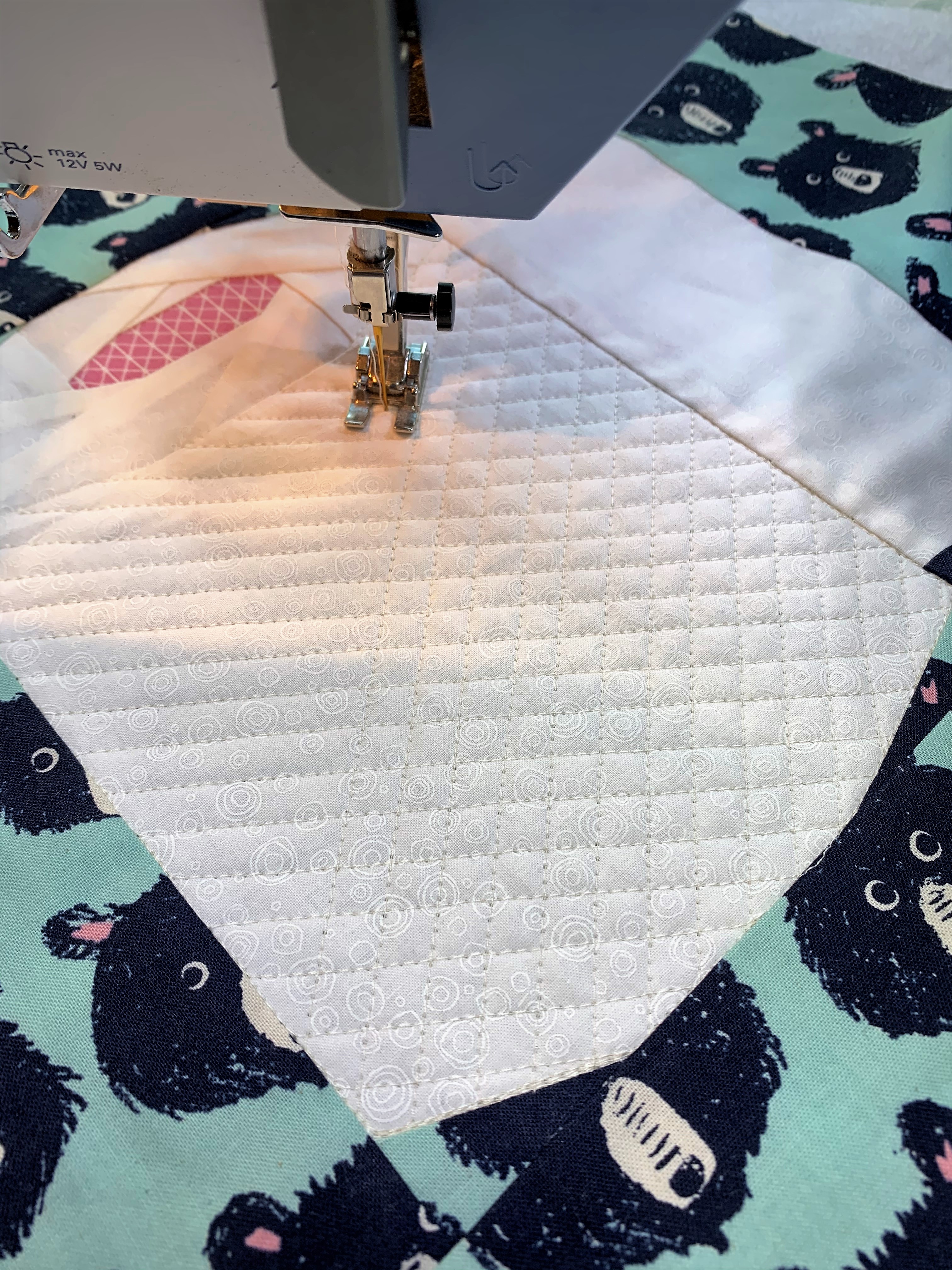
Last weekend, I loaded Meowville onto my frame to start quilting. I’m using Glide thread in Celery in the giant cat head and letters, and using Glide thread in black for the remainder of the quilt. I’m going to keep the quilting very simple to keep the focus on all of those wonderful tiny houses!

Time for quilting!
A cute heart quilted into a paw

I’m about 2/3 of the way finished with the quilting, and I expect to finish this week. I’ll post a picture of the completed quilt soon! I have 2 more quilt tops ready to be quilted for the show so I need to get to it!

Happy quilting,

Jen

An Epic Tiny House Paper Pieced Project

Hi everyone!

Last year, I participated in a weekly tiny house sew along designed by Quilt Art Designs. These are 6-inch blocks with very small foundation paper pieced sections with a total of 36 houses. This project was designed as a scrap buster, but my scrap bin is still overflowing!!

I kept up with the weekly sew a long and you can find all of my individual houses posted to my Instagram account @nwquiltedcat or by searching on the hashtag #meowvilletinyhouses.

For my houses, I decided that I wanted to incorporate little cats into each house. I fussy cut various cat faces and cat bodies and pieced them into each block.

I put these blocks to the side for a few months to ponder how I might finish this project, and I recently put them up on my design wall. These are all of the tiny houses pieced together in rows, but the rows are not yet sewn together.

I decided to call my little village, Meowville! I used paper pieced letters designed by Sam Hunter in her book, Quilt Talk.

Meowville banner for my tiny house village!

I’m leaning towards adding an inner solid border around the tiny houses, and then adding a wider outer border with the Meowville banner, some paw prints, and maybe a paper pieced cat or two. Stay tuned!

Happy sewing,

-Jen

Fierce Cheetah Mama

Happy spring, everyone! The days are getting a little longer, bulbs are blooming, and birds are singing. I’m very happy that we’re heading into the warmer spring days because it means more hiking and gardening.

For Christmas last year, my sister sent me the Cheetah Abstractions pattern by Violet Craft. This is a foundation paper pieced pattern that usually finishes at 48 inches by 60 inches, but I decided to shrink it down to 75%. I like to print my foundations using Carol Doak’s Foundation Paper because it is really easy to remove after sewing.

I challenged myself to use only fabrics from my stash. The fabric audition process can take a few days and, for this quilt, my hardest decision was the background. I knew that I’d need about a 2 yard piece in a solid or mostly solid color with enough contrast to make the cheetah body pop. I auditioned creams, grays, grunges, and others until I came across a mottled light aqua fabric. Perfect! It reminded me of a partly overcast day.

Once I had the background fabric, I pulled different solids and lightly patterned fabrics to audition for the cheetah body. I like to use Violet’s included color palette to tape small swatches of my fabrics so that I remember which fabric goes with which symbol while paper piecing.

Cheetah Abstractions – fabric selections

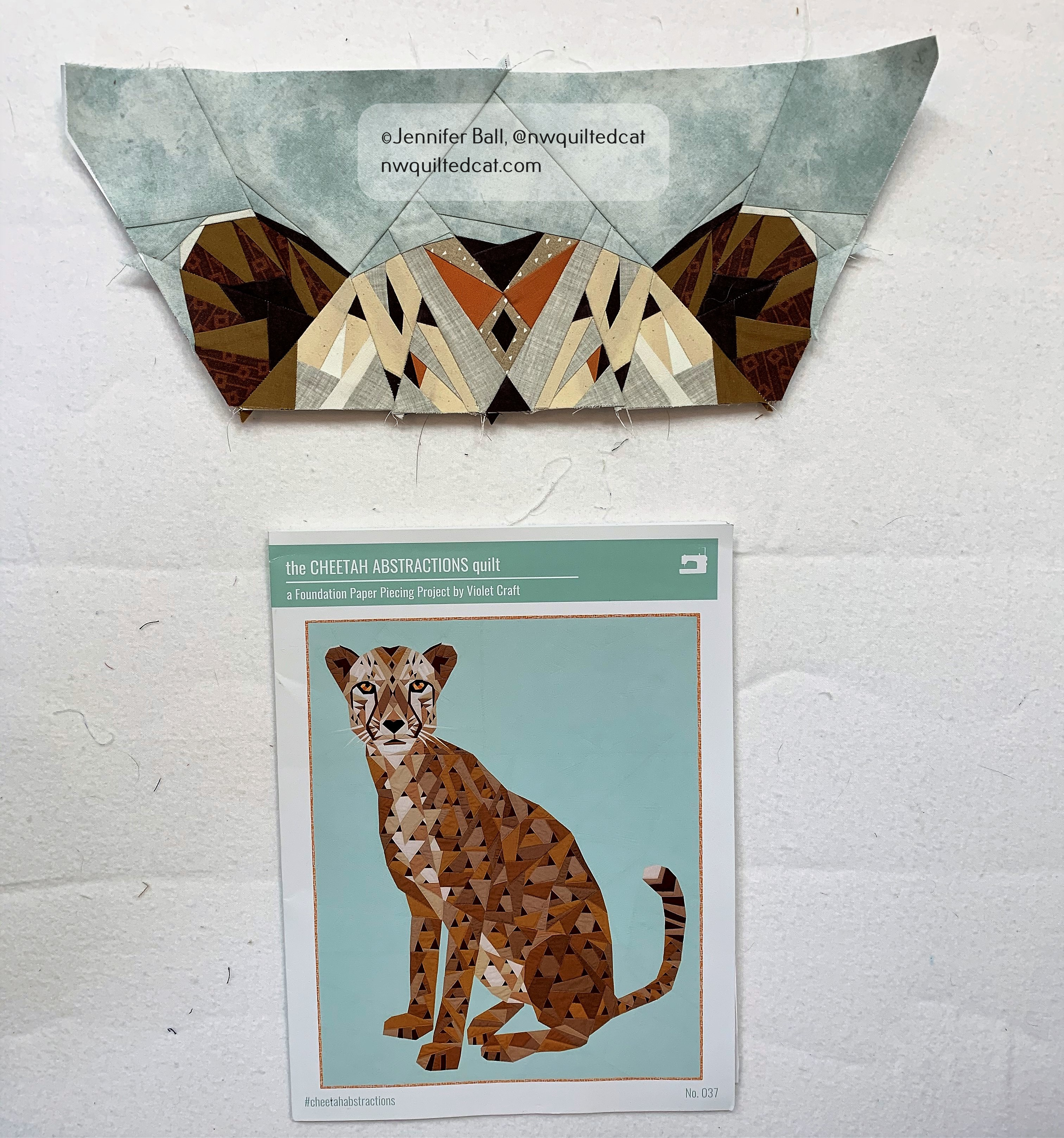
I started with the cheetah face first. I was just so eager to see it come to life in fabric! The head section is the most complicated, especially at just 75% size. If you’re new to paper piecing, just go slow and remember to reduce your stitch length. Here’s the start of the cheetah with the pattern for scale.

Over the next few days, I tackled sections of the cheetah body. I sewed the smaller sections and laid them out before joining sections together. It is much easier to fix mistakes this way! Isn’t her expression great? Her gaze is so intense and focused.

I pieced my cheetah fairly quickly in just a few weeks. I put all my other projects (mostly) on hold. Once pieced, I thought about how to quilt her for a week or two. I didn’t want the quilting to detract from the magnificent cheetah mama.

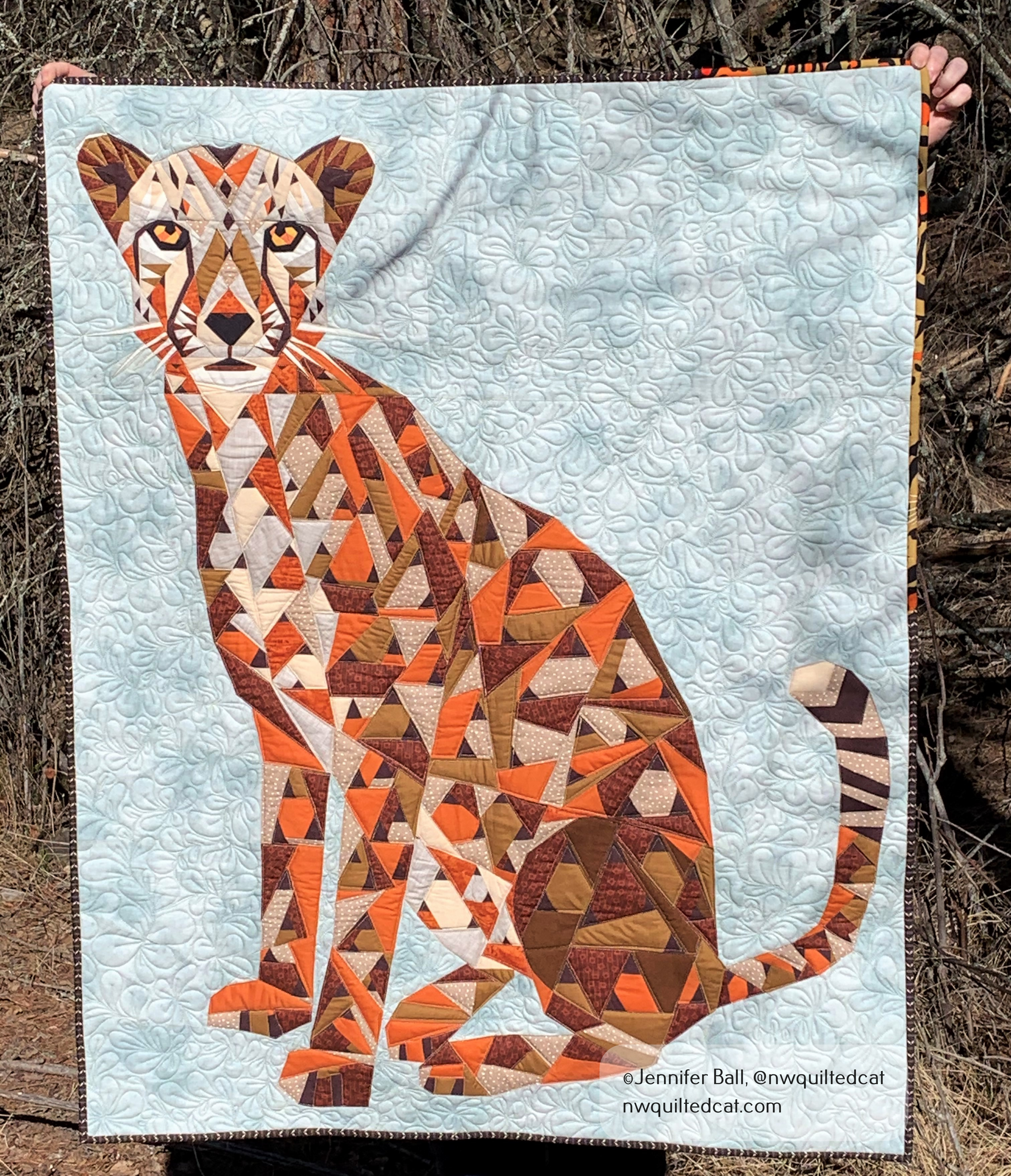
I decided to do some straight-line quilting all over the cheetah face and body using Glide thread in Sand Dune. For the background, I did some free-motion leaves using Glide thread in Cool Mint. I also used 2 layers of Quilter’s Dream Poly Select batting for extra texture!

The double batting does make this small quilt heavy, but I plan to hang it on a wall rather than using it as a lap quilt. For the binding, I used a dark brown fabric for three-quarters of the quilt and then used a piece of the backing for the remaining one-quarter to accent some of the colors from the cheetah.

The backing fabric is called Kenyan Cats by Alexander Henry Fabrics, which I thought worked so well with the cheetah theme.

I really love how this fierce mama cheetah quilt turned out, and I can’t wait to display her on a wall behind my work desk at home.

Enjoy!

~Jen

A Traveling Quilt Takes an Adventure!

Hi everyone,

Last week would have been the 45th anniversary of the Sisters Outdoor Quilt show. I had planned to take classes the week before with my sister, but the classes are postponed until 2021. We decided to have a mini retreat together for some sewing and hiking.

We had fun sewing on small projects in our hotel room, visiting local quilt shops while maintaining social distancing protocols and wearing masks, and hiking in the great outdoors.

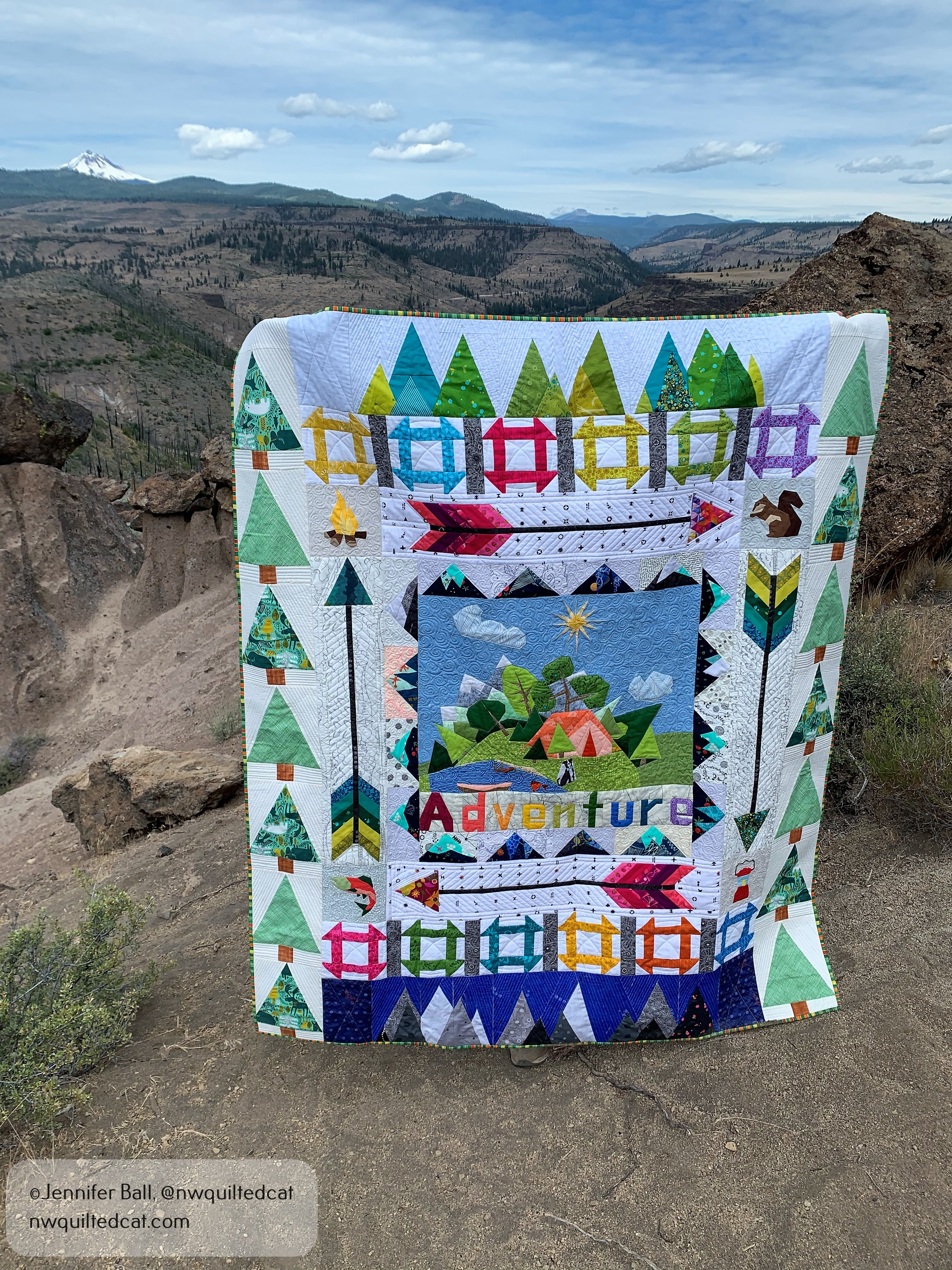
I took my Adventure themed traveling quilt with me. I made the center foundation paper pieced block from a pattern called “Camping” by Quilt Art Designs, but without the road and camper van. I also paper pieced the word “Adventure.” My quilt then traveled for about a year around the United States, where 5 different quilters added sections. In return, I added sections to the other quilters’ traveling quilts, all with different themes ranging from Harry Potter to books to gnomes.

Here’s a look at my center block, with and without the word, Adventure:

Each quilter was free to add her own ideas to the quilt, keeping with my theme of travel and adventure.

  • Marianne added an inner border of foundation paper pieced mountains
  • Katie added the next border of foundation paper pieced arrows, a squirrel, a campfire, a fish, and a lantern
  • Kitty added churn dash blocks (one of my favorite blocks) to the top and bottom
  • Gigi added a mountain range in the day to the top and a mountain range in the night to the bottom
  • Jenn added the final left and right borders of trees

I received the quilt back this spring, and then decided to custom quilt it using ruler work and free-motion.

Here is a look at the finished quilting with my dog quilt inspector:


Completed quilting on Adventure quilt with Pepper “helping”

My sister then helped me to photograph this quilt while in central Oregon last week. It was quite windy so it was difficult to hold the quilt still and get a good picture.

We took these pictures at Balancing Rocks, which are volcanic tuffs.

Adventure quilt at Balancing Rocks with Mt. Jefferson in the background

Adventure quilt near a volcanic tuff

I really enjoyed my first experience as part of a traveling quilt/round robin group. I even got to meet one of the quilters in person in July 2019 at the Sisters Outdoor Quilt Show, where she brought me the next quilt in line for my additions. I hope to participate in another one in the future.

Happy quilting!

Jen

Introducing Alfie the Alpaca Foundation Paper Pieced Pattern!

Hi everyone,

I’m so excited to introduce you to Alfie the alpaca! I designed this cute alpaca block for a mini quilt exchange with my sister.

Alfie is foundation paper pieced, suitable for quilters with some paper piecing experience. The block size is about 16.5 inches by 8 inches before adding borders. The pattern does include instructions for adding the same size borders as shown in my finished quilt.

You can purchase Alfie for just $4 on my Etsy store, QuiltedCatPatterns!

Let’s take a closer look at Alfie the alpaca! I based this pattern on a photo that I took of a cheeky little alpaca in Sisters, Oregon during summer 2019. I used Cherrywood fabrics for the alpaca body, and Pie Making Day in Key Lime from RJR fabrics for the background. I pieced each section of the pattern, and then pinned the sections to a design board before stitching them together. This process helps you to catch any fabric placement mistakes before the whole block is stitched together.

The picture on the left shows all of the individual foundation sections pieced. The picture on the right shows the sections as I started to sew them together into units. I love watching foundation paper piecing patterns come together!


Alfie the alpaca block without borders

After I sewed all of the sections together, I decided to add some off-set borders to the Alfie block. I used a very narrow inner border from a peach colored Grunge fabric on the left side and along the bottom side. This peach fabric matches the peach tone of the blankets on the llamas in the outer green border.

I knew that I would add the dark green outer border before ever designing this block. My sister picked out this fabric as our challenge fabric for our mini quilt swap. We each had a fat quarter to use in our mini quilt somewhere. The llama fabric is called Llama Life Faraway Places by Cloud 9 Fabrics.

I also auditioned many fabrics for the bottom border, and finally settled on a black and white square print that I had in my stash.

I did simple quilting with an all-over meander on Alfie’s face and body using Glide thread in Linen and Bone, free-motion swirls using Glide in Celery in the light green background print, and some diamond shapes in the dark green border. I also free-motion quilted “Alfie” in Glide Apricot Blush on the bottom border.

Alfie the alpaca block without hair

I thought Alfie might be missing something, some integral part of his cheeky self. I figured that he needed some hair!! I went to a local alpaca farm and purchased some alpaca yarn in a shade to match Alfie’s head.

I used a couching foot on my Bernina to sew the yarn to Alfie’s head in little swirls. I love the texture and dimension that the yarn added to this mini quilt. I think it brings Alfie to life!

Adding alpaca yarn to make hair

Here’s a look at my Alfie completed mini quilt from a recent day hike with his fluffy head and shorn body:

Alfie the alpaca mini quilt with avalanche lilies

I hope you enjoy my new pattern, Alfie Alpaca available now for purchase. I’d love to see a photo if you make something using this pattern!

Happy quilting,

Jen

2020 Mini Series SAL – Week 7

Happy Thursday, everyone!

This week, we are working on block 7 called the “Curved Cabin” in the Mini Series sew-along hosted by Giucy Giuce and Alison Glass.

This block is comprised of 4 tiny sections, giving you the ability to create many different looks from one block depending on your fabric choices and fabric placement. Each tiny section is 2-inches by 2-inches (finished measurements).

I’m continuing my color scheme by using a Kona charm pack in Mermaid Shores with a batik background that reminds me of tiny beach pebbles.

The pieces in each section are tiny! I narrowed my final block assembly to these 3 options:

I think it’s so wonderful how this block can completely transform depending on my layout! I really liked options 1 and 2, but I ultimately went for option 1 because I do enjoy the center circle that emerged.

My Curved Cabin block with a little frog friend!

I think a quilt made just from this block would be a fun project in the future. I could make the blocks all the same, or maybe do an ombre effect.

Here’s a look at my blocks together:

Mini Series SAL, blocks 1 to 7

We now have 7 out of the 8 blocks in the Mini Series completed. There is 1 bonus block available to the participants only, so I plan to make it next week along with the final block.

If you are participating in the SAL, I’d love to hear about it. Leave a comment and let me know your Instagram handle.

Happy quilting!

~Jen

2020 Mini Series SAL – Week 6

Hi everyone,

Happy weekend! We are getting some spring rain showers, which I’m sure the plants are loving. I planted a few color spots in some patio containers recently so all those tender roots are enjoying this mild weather. We are supposed to get some warmer sunny days later in the week, which I will love!

Today is the end of week 6 in the Mini Series sew-along, hosted by Giucy Giuce and Alison Glass. We made the Triangle Geese block this week, and it went together pretty fast!

I’m continuing to use my Kona cotton charm square pack called Mermaid Shores with a lovely batik background that reminds me of tiny beach pebbles.

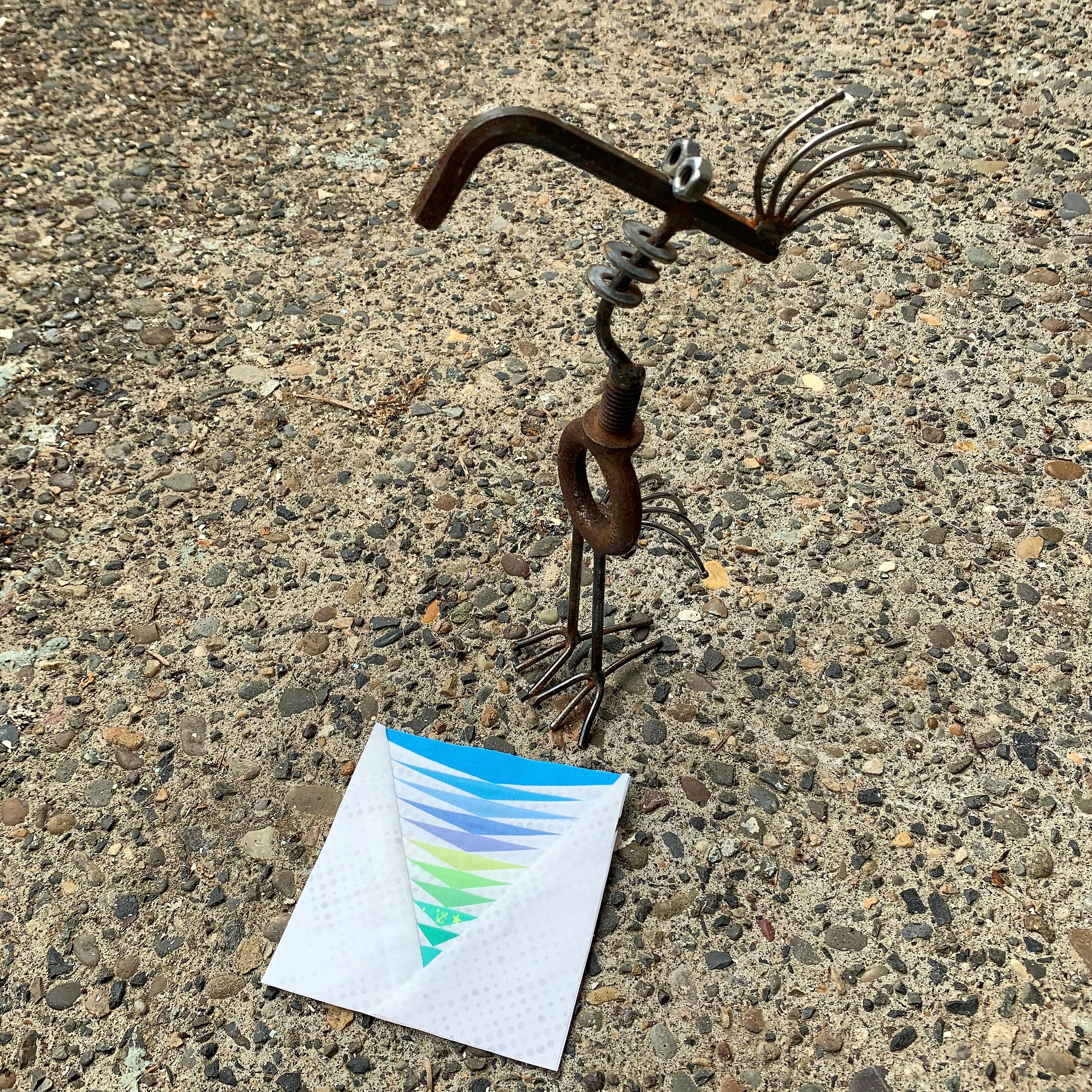
Here’s a look at my Triangle Geese block with my friend, Victor. He’s wondering where the path might lead him . . .

Victor poses with my Triangle Geese block

Well, in Victor’s case, the Triangle Geese block was going to lead to the other blocks that I have sewn so far in the SAL, but my quilt inspector, Cow, had other ideas.

This picture is what happens when trying to photograph quilt blocks with a curious cat. Of course, as soon as I took the picture, he feigned disinterest and started to take a bath. Victor is quite shocked!

Cow, the quilt inspector, interrupts the photo taking

Eventually, Cow decided that taking pictures of miniature quilt blocks was too boring for him, and he strolled over to the grass to watch birds.

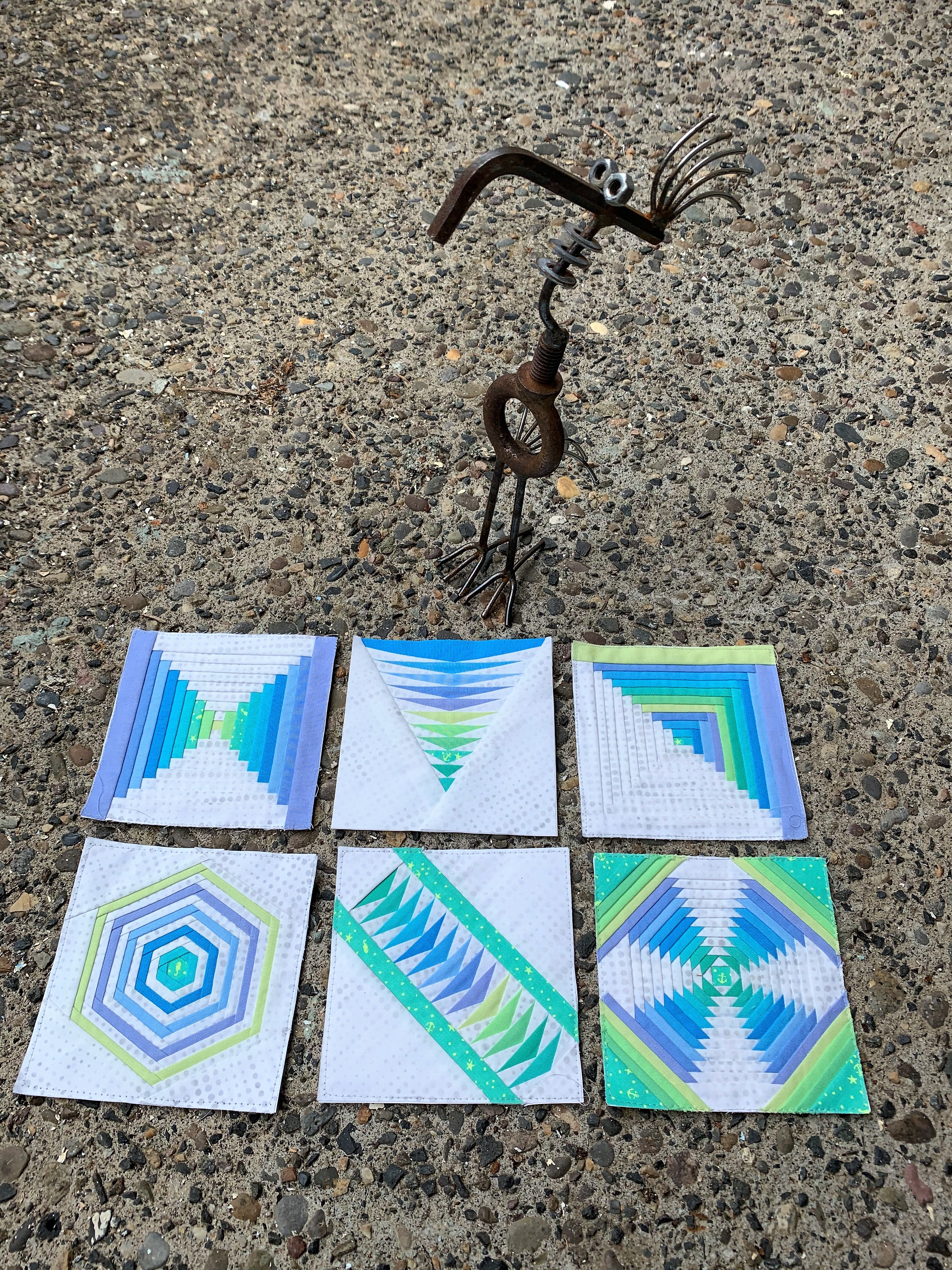
I got another picture of Victor with all 6 of my blocks. Victor is still miffed, but decidedly happier to have the blocks all to himself.

Victor with blocks 1-6

We now have just 2 blocks left in this SAL before creating a finished project. I’m still undecided on my project, but I have a few ideas that I’m pondering.

Happy quilting!

~Jen

Mini Quilt Reveal for COVID-19

Hi everyone,

Yesterday, I posted about creating a mini quilt to acknowledge this current pandemic. I wanted a project that I could make quickly with supplies on hand.

I finished the quilting and binding last night so that I can share my completed mini quilt with you today. I used my Oliso mini project iron for each step of foundation paper piecing, and I really loved the convenience!

I used my Bernina domestic sewing machine to do some cross-hatch quilting on the toilet paper roll. To get started, I like to use a piece of Washi tape. This tape gives me the placement for my first line of stitching. I then use my presser foot to guide my along that first line to complete the rest of the quilting.

I used Aurifil 50 weight thread in silver white (#2309) for both the piecing and the quilting.

Use Washi tape for cross-hatch quilting

Cross-hatch quilting on my Bernina

I kept most of my quilting to the toilet roll portion of the quilt. On the borders, I did just a couple of lines of straight-line quilting in Aurifil dark pink (#4020). I also used this same dark pink thread to complete my binding entirely by machine.

If you missed my post yesterday, this mini quilt is a free pattern by Miso Quilty called Keep Calm and Roll On.

Here are some pictures of my completed mini!

This mini quilt comes together very quickly, especially if you have a little foundation paper piecing experience. I think my total time to complete the quilt was about 3 hours. I did speed up the process by doing machine binding rather than hand binding because I’m just going to display this mini in my guest bathroom.

Happy quilting!

Jen